



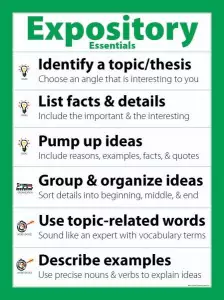
There are three main types of expository essays: scholarly writing used mainly for academic purposes, which describes or examines a process in a comprehensive way; analyzing a concept, which describes and explores a written work or an event; also, expository essays can set out and explain detailed instructions or a description of a method or procedure.

✅ AI Essay Writer ✅ AI Detector ✅ Plagchecker ✅ Paraphraser
✅ Summarizer ✅ Citation Generator
It is not always easy to separate these three types. It does become clearer after one has decided on a topic and found a way to present an argument about it.
Steps for Writing an Expository Essay
- Choose a topic in which you already have some interest. The more you know, the better, and reading about a subject that you like will ensure you remember more, make sensible notes, and enjoy the writing process. Your topic should be specific, not general, so that the essay is interesting, and the supporting references will support the argument well.
- Appropriate material from which references can be drawn must be found. Journals, books, articles, and online materials are suitable, as long as the references are scholarly.
- Write a thesis statement that articulates the overriding idea. This must capture all the elements of the concept you intend to express.
- Decide on a system or style of development. You can choose among the following, making sure your method matches your topic:
- Making an example
- Using cause and effect
- Assembling a classification
- Comparing and contrasting
- Analyzing a process
- Defining and clarifying
- Start drafting. Create a number of points, find research to support them, and use the source and reference as support for each point you make.
- Write a topic sentence for each body paragraph, and provide a well-written topic sentence that directly relates to the thesis sentence. Then proceed to fill out each body paragraph with clear reasoning. After this:
- Write a summarizing conclusion by making sure you mention your thesis and points. In case you’re hesitant, you can use the A*Help free summarizing tool.
- Close the essay in an effective manner, supplying an afterthought for your readers to keep their curiosity about your chosen subject.
- Make sure you do not introduce new material in the last paragraph.
- Write the introduction last, as it must state the underlying thesis of the essay, introduce what is discussed in the body paragraphs of the essay, and interest the reader from the very first words.
Expository Essay Topics
There are actually a lot of topics you can choose from when writing an expository essay. You can pick among issues, questions, and trends that exist in such fields as politics, economics, history, culture, science, health, programming, and so on. Several possible topics for an expository essay are listed below:
- Explain the requirements of an unusual major at your school (like aviation, fashion design, astrophysics, Japanese, or international studies).
- What is the history of your college?
- What happens to juveniles who break the law?
- What is homelessness? What causes people to be homeless?
- What is the Salvation Army? How do they help the needy? (Or choose another non-profit charity that helps the poor)
- What are the effects on a family when a parent becomes a meth addict?
- What causes teenagers to run away?
- How does having a single parent affect children in the areas of education, hygiene, and nutrition?
- How do people without health insurance get medical treatment?
- What is it like to be an illegal alien?
- The unstudied impacts of cellular phones on health
- The problem of childhood obesity in Texas
- Social tensions of foreigners in Japan with locals
- Threats posed by countries with nuclear weapons
- Bullying as a serious problem in public American schools
Key Points to Consider
- Describing a procedure or process need not be boring. Find an interesting way to present material to the reader without overwhelming details.
- Compare and contrast aspects of your topic in two ways: different methodology found in literature, or alternative ways used by different scholars or experts.
- If you are using the ‘cause and effect’ method, ensure you match each pair correctly and support each example with a citation to demonstrate its reliability. It must also have relevance to your topic.
- When attempting to classify, write in a clear and simple way.
- Examples chosen to demonstrate or illustrate an argument must be suitable. A way to decide if an example is appropriate is to try to argue against it yourself. If you succeed, it was not an appropriate example.
- Defining is not as simple as finding its definition in a dictionary and copying the description. Many authors start a book or journal article by writing a definition without resorting to dictionaries, using excellent quotes instead.
Do and Don’t
Do
|
Don’t
|
Common Mistakes
-
- Building a whole exposition based on a single opinion: yours. You need to introduce an alternate perspective, which is well-supported by reputable references.
- Styling the essay in an emotive way: all language you use needs to be as calculated and unemotional as possible, with reasoning based on research.
- Using commonplace language instead of a scholarly tone.
- Changing your perspective during the development of your argument. Being swayed by one piece of research, and then showing a conflicting argument in a subsequent paragraph is demonstrating a lack of mental discipline.
- Lack of planning.
- Use of irrelevant or inaccurate vocabulary. The vocabulary of an expository essay needs to conform to the topic and discipline.
- Too few or too many references. Students must take care not to overload an essay with too many facts and quotes from literature. Short essays of less than 2000 words rarely need the support of more than four sources. By the same token, long research works of over 5000 words need the backing of more than four sources.
Now that you have acquainted yourself with the basic expository essay writing tips and rules, you can check out our expository essay samples to link theory with practice.
Follow us on Reddit for more insights and updates.
Comments (1)
Welcome to A*Help comments!
We’re all about debate and discussion at A*Help.
We value the diverse opinions of users, so you may find points of view that you don’t agree with. And that’s cool. However, there are certain things we’re not OK with: attempts to manipulate our data in any way, for example, or the posting of discriminative, offensive, hateful, or disparaging material.
More from Writing an Essay



Thank you for the clear guidelines.